The hummingbird appears without warning, a jeweled blur materializing at the purple blooms along the pathway. Its wings beat so rapidly they vanish into shimmer, an impossibility of flight suspended between breath and heartbeat. For a fraction of a second, the world contracts to this single moment: iridescent emerald against soft violet, urban pathways forgotten behind a veil of bokeh.

The San Diego Zoo harbors more than a thousand bird species across its hundred acres, from the smallest finches to towering cassowaries. But size tells only part of the story. Here, conservation meets spectacle, scientific research intertwines with public wonder, and visitors encounter creatures whose existence seems both familiar and utterly alien.
PORTRAITS IN CORAL

The flamingo habitat stretches along a shallow lagoon where tropical vegetation frames water's edge in shades of green and gold. One bird stands apart from the flock, neck curved in that signature S-shape, its plumage radiating coral and deep orange in the natural light. Behind it, dozens of its companions wade and feed, a living tapestry of pink against aquamarine water.
Their color comes not from pigment but from diet—algae and crustaceans rich in carotenoids that the birds metabolize into those impossible shades. In captivity, maintaining that vibrancy requires careful nutritional management, a daily reminder that beauty in nature often depends on invisible networks of sustenance and care.
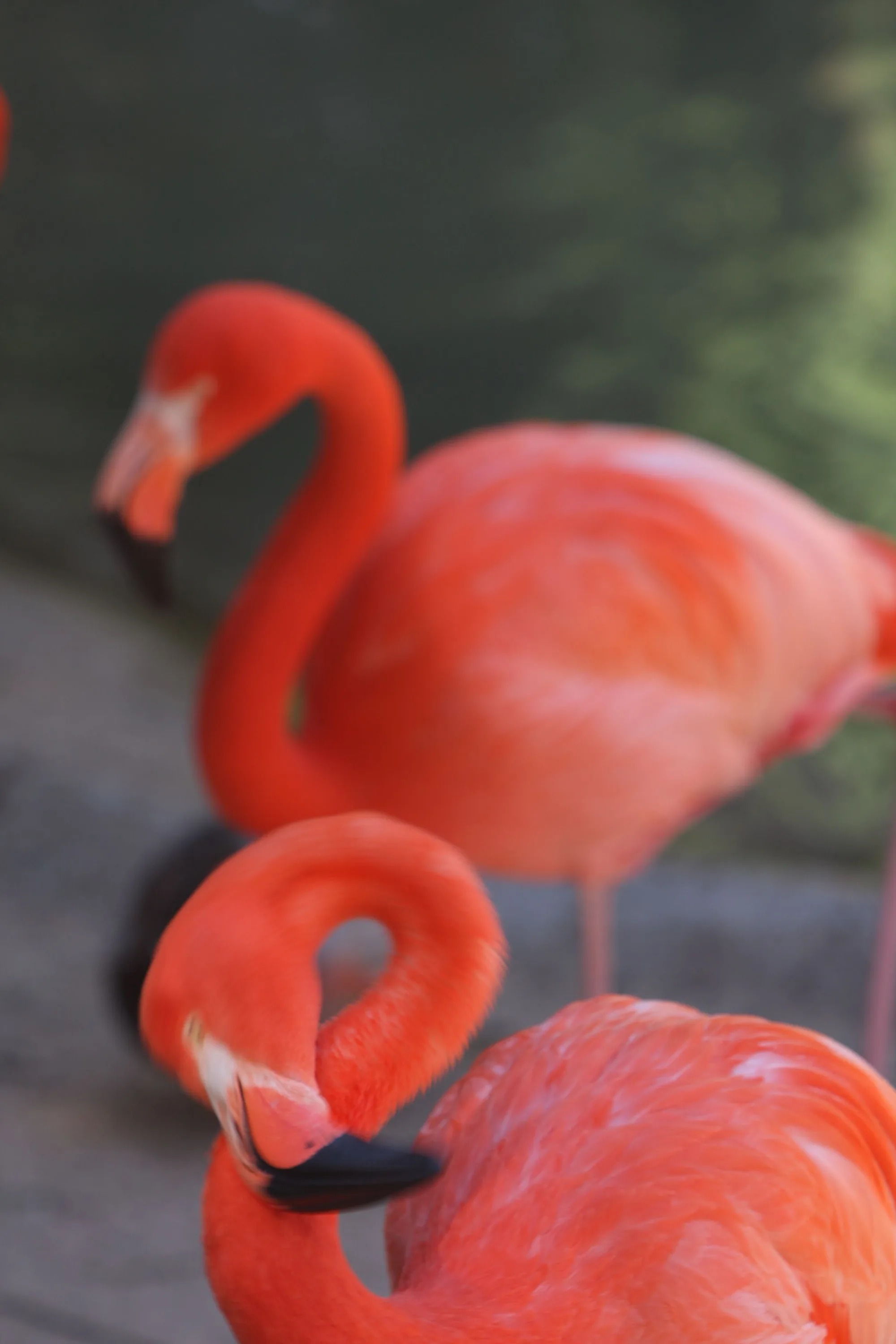
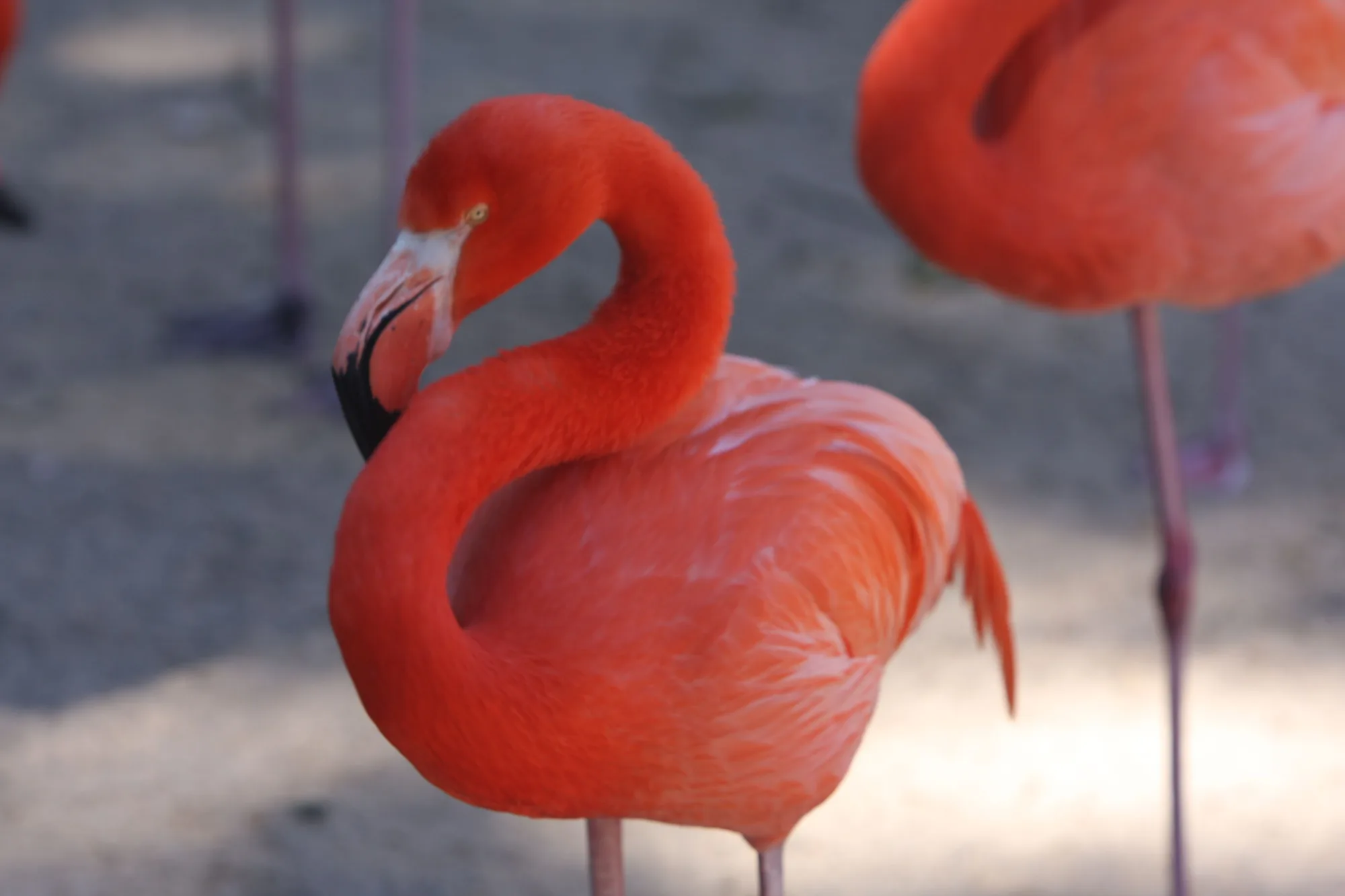
Watch them long enough and individual differences emerge. One bird's neck curves more dramatically, another's plumage burns redder, a third moves with particular deliberation. The flock appears uniform from a distance, but intimacy reveals variation—each flamingo a slight deviation from the template, each one singular despite the crowd.
The flock appears uniform from a distance, but intimacy reveals variation—each flamingo a slight deviation from the template.
WETLAND CHOREOGRAPHY

The mallards attack their bath with theatrical vigor, transforming calm water into chaos. Wings beat against surface tension, metallic green heads disappear into spray, purple-blue wing patches flash like semaphore signals. The bathing ritual serves practical purpose—distributing oil from preen glands across every feather—but watching it feels like witnessing pure joy.
Elsewhere in the zoo, quieter dramas unfold. Three Inca terns perch together on bare branches, their charcoal plumage broken only by scarlet beaks and eye patches. They sit motionless, alert to something beyond human perception, their bodies forming a perfect triangle against the bokeh of green and white behind them.

TROPICAL JEWELS
As afternoon light warms to gold, a blue-crowned motmot materializes on a weathered branch. Its turquoise crown catches the angle of sun, throat glowing lime-yellow against olive breast. The bird sits with preternatural stillness, embodying the patient watchfulness of tropical forests where movement means survival and motionlessness means invisibility.

The motmot represents one of the zoo's central missions: bringing species from distant ecosystems into proximity with visitors who might never encounter them in the wild. Native to Central American forests increasingly fragmented by development, these birds serve as living ambassadors for habitats most people will only ever see through glass or across moats.
THE CROWNED ONES

The secretary bird defies easy categorization. Part raptor, part runway model, it perches on its nest of twigs with crown feathers radiating outward like a punk rocker's mohawk reimagined by nature. The dramatic plumes earned the species its name—they supposedly resembled the quill pens secretaries once tucked behind their ears—though the comparison feels inadequate to the bird's theatrical presence.
In the wild, these African hunters stalk grasslands on impossibly long legs, stomping snakes to death with their powerful feet. Here at the zoo, nesting behavior reveals another dimension: the careful arrangement of twigs, the patient incubation, the fierce protection of territory. Predator and parent occupy the same improbable body.

The final image captures the bird from behind, crown feathers spread like a fan against blurred red flowers. It's an unexpected angle, slightly comic, deeply endearing—a reminder that nature's grandeur often appears in the least likely perspectives. The secretary bird's theatrical plumes, the motmot's jeweled stillness, the flamingo's impossible coral, the hummingbird's vanishing wings: each represents an evolutionary solution to survival dressed in such extravagance it becomes art. The zoo preserves not just species but wonder itself, making visible what distance and habitat loss increasingly hide.